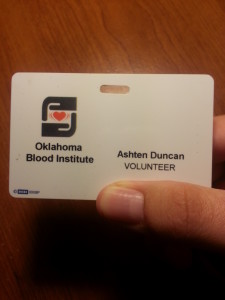
Ashten Duncan
I am a senior at the University of Oklahoma pursuing a major in Microbiology and minors in French and Chemistry. I will be attending medical school in Tulsa next year. I have been donating blood since 2011.


As I stood in my high school’s gym back in 2011 during an annual blood drive, I reflected on what I was hoping to do there. I never imagined that donating blood would become something routine in my life and something of great and lasting importance. It was my first time waiting to go through the donor screening process, and I remember being rather apprehensive at the thought of donating. While I watched a few students from time to time drop out of line due to anxiety getting the best of them, I reassured myself that this experience was not only going to be good for the larger community, but was also going to be good for me as an individual. After making my way over to the collection area, I lay upon one of the available beds and looked pensively at what was around me. Student donors and phlebotomists filled the immediate vicinity, all busy with their respective tasks. It was amazing to see how a small community had formed in this one unassuming place at my high school, a community committed to advancing the purpose of the Oklahoma Blood Institute. In fact, the sight of everyone coming together for such a noble purpose deeply inspired me to become more involved in my community in order to bring about positive change, and this inspiration has remained with me even to this day.
Once I started my degree at the University of Oklahoma in 2012, I began looking into the many things that I would need to do to make myself a competitive applicant for medical school. Since I found volunteering and donating blood so fulfilling in high school and knew that community involvement would help to enhance my application to medical school down the line, I made it a point to increase my involvement in the community by participating in more volunteer work and leadership roles in campus organizations. One organization that quickly became a major influence on my ability and desire to serve the community was called Alpha Phi Omega, a national co-ed service fraternity. Through Alpha Phi Omega, I became more engaged with the Oklahoma Blood Institute through volunteering at blood drives. During the Bedlam blood drive for the 2013 fall semester, I was complimented on a few occasions by the staff members on my enthusiasm as I facilitated donor flow. Their kind remarks led to a number of conversations I had with them about the Oklahoma Blood Institute and some of the other things the organization does aside from blood drives. Wanting to learn more about the inner workings of the organization, I asked the volunteer coordinator, Julia Davis, about any potential internship or research opportunities that might have been available. The fact of the matter was that such opportunities did not exist at that time, but the connection I had made with the staff members at the blood drive opened up the door to an interesting summer internship involving the medical director, Dr. Walter Kelley, and his research.
Several months following the blood drive, Julia was able to connect me with Dr. Kelley who was eager to meet and discuss the plans for the summer. When we met in his office for the first time, I was not sure what to expect and, consequently, felt nervous about what this physician would think of me as a potential research assistant. After a few minutes of talking to him, my initial nervousness faded away, and I was greeted with a pleasant feeling of mutual respect, which would serve as the starting point for a wonderful mentor-mentee relationship. I felt that Dr. Kelley and I connected with one another quickly, and the connection served to make the research work incredibly enjoyable and fulfilling for me. From there, Dr. Kelley and I would meet up from time to time to have lunch or just to have a conversation in his office about life, the medical school application process, and the importance of being happy. Every conversation was nothing short of inspirational for me, and it changed my perspective on many aspects of life, making me a happier, more confident, and wiser man. The conversations also seemed to give Dr. Kelley some ideas about things he could show me around the Oklahoma Blood Institute main office building in Oklahoma City.
One day, Dr. Kelley was kind enough to take me to the area of the building where peripheral stem cell and bone marrow donors would sit to receive pre-donation treatments and to go through with the donation process itself. As I watched one of the nurses collect life-saving peripheral blood stem cells from a donor, I thought back on my previous blood donations and how those may have changed somebody’s life. The stem cells that the nurse was collecting were of tremendous importance, giving somebody in need a new lease on life. In a similar, some of the pints of blood I had donated may have gone to save somebody whose life was hanging by a thread. I then went with Dr. Kelley to see the storage area for stem cell products. The experience of being in the donor area and the stem cell storage area motivated me on a deep level, giving me new insight into the importance of making blood donations. For the rest of the time, I doubled my efforts as I continued working on my projects, including the research, I had as part of my summer internship with the Oklahoma Blood Institute.
The summer proved to be exceptionally fruitful in the end. As a result of the research I did with Dr. Kelley, a paper over the work was published back in August 2015 in the Journal of the Oklahoma State Medical Association. Aside from serving as a reminder of the meaningful experiences I had during that summer, the publication also served as a strong credential when it came time for me to apply to medical school and helped to build strong self-confidence when I started going through the interview process. As I continued to donate blood, I would talk with the phlebotomists at my local donor center in Norman about the work I had done and about my hopes of being accepted to medical school. The more conversations I had on the topics, the more I realized how many connections I had made with so many great people along the way. It astounded me to think about where I had started and where I was at that point in time. Since then, I have been accepted to the University of Oklahoma’s School of Community Medicine in Tulsa. I attribute the connections I made with other people to the success I have had. In fact, the connections I have made are still strong, especially with Dr. Kelley who will be attending my white coat ceremony in August.
I owe so much to that day back in high school because, if not for that first blood donation, I do not feel that I would have been able to achieve what I have. Donating blood is now a powerful symbol for me that represents the life that a single person can breed into a community and the way that same community can reciprocally empower that person to do more for others. The most valuable thing I have gotten out of donating blood has been connecting with other people in ways I otherwise never would have. When you give of yourself, whether through blood donations or something else, in such an unconditional way, you help build a stronger and more prosperous community around you, and this empowered community can help you achieve your highest goals in return—for me, this was being able to attend medical school. My suggestion to any who are able to donate blood and are seeking a way to impact your community in such a profound manner is to get involved with organizations like the Oklahoma Blood Institute. I promise that it will change the way you view your community and its importance in individual lives, including your own. For as long as I can, I will continue to donate blood, with the goal of furthering the relationship I have with my community in an effort of unconditional service.