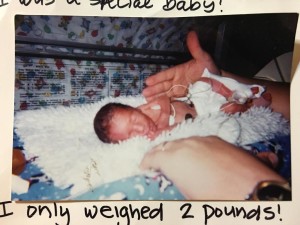
This past winter, I visited my family for Christmas. I knew it would be the last time I would see my cousin Michael before he left home, for the first time, to do a semester-long internship with the Disney Company in Orlando, Florida. I made sure to spend lots of extra time with him; and one day, as we were sitting in a frozen yogurt shop mulling over our plans for the future, he casually mentioned that he was nearing his twentieth birthday. As it turns out, that day is important to him not as a cause for celebration, but for the memory of an unfortunate circumstance that put his life in jeopardy. At the time, when I asked him to explain, he said that it would be too emotional for him, that I should ask my aunt whenever we got back home. Later that night, as the whole family sat at the large dinner table in my grandmother’s house, my aunt explained the ordeal in vivid detail.
In the fall of 1995, my newlywed aunt and uncle were happy to discover their first child was on his way. With this new discovery, the young couple excitedly started to prepare everything for the arrival—the color of his nursery walls, the clothes he would wear, the milk formula he would use, even the bibs and pacifiers he would need. Most of all, they began to dream about his future, which they hoped would include attendance at the best schools their small city had to offer and the opportunity to go on and do bigger and better things.
The months passed, and by the beginning of May, when my aunt’s feet started swelling, my uncle grew nervous; and the anticipation for the arrival of the newest member of their family became unbearable. However, when my aunt started experiencing contractions three months before her due date, their anticipation turned into fear and panic. They had heard, of course, lots of stories about women going into labor prematurely, had learned that it isn’t uncommon and that modern medicine has advanced in favor of saving a preemie baby’s life. Quite understandably, that knowledge didn’t stop my aunt from sobbing uncontrollably on the car ride to the hospital. She was admitted and examined, and it was confirmed that she was having her baby boy.
My aunt was rushed into the delivery room and quickly hooked up to monitors and IVs, while my uncle was moved to a sitting area to wait in excruciating uncertainty over the survival of his first child. Hours rolled by until finally a nurse came out and explained that his son Michael had been born prematurely, but healthily, and was being transferred to a neonatal intensive care unit until he grew big enough to be taken home. It was hard for my aunt and uncle to see their child in such a state. His life was dependent on machine, and the beeping of the monitors and the sight of the C-PAP (continuous positive airway pressure) down his throat forced them into tears.
Eight days after my aunt had been discharged from the hospital, she received a frantic phone call from the NICU nurse telling her Michael had taken a turn for the worse. Somehow, he had contracted an infection which threw his tiny, undeveloped immune system into a tailspin. More specifically, he had necrotizing enterocolitis, an infection in premature babies which causes inflammation that can ultimately destroy the wall of the intestines. The paralyzing fear that had gripped my aunt and uncle just a week and a half before returned as they rushed to the NICU. The infection had already caused severe damage to his intestine—a hole had formed which allowed bacteria to spread throughout his whole body. At this point, it was a medical emergency. After a storm of x-rays, blood tests, and IVs, it was determined that Michael needed an immediate transfusion.
The first transfusion saved my cousin’s life. It gave him the cells he lacked to combat the infection and repair his intestine. The second stabilized him and allowed him to heal through all the antibiotics and blood tests. Without those two transfusions, those two pints of blood, my cousin wouldn’t be here today. Without those two pints, my aunt and uncle would have lost their first child. My aunt finished the story in tears, but not tears of sadness, but rather of gratitude to the two donors who saved her son’s life nearly twenty years ago.
Today, Michael is pursuing a degree in music production, volunteers at his church, and gives his own blood as often as possible. Because Michael is here today, thanks to two miracle pints of blood which were luckily readily accessible and safe, he is constantly spreading awareness of the issues facing people needing transfusions in countries around the world. So often, patients in need of immediate transfusions don’t have access to available and safe blood; and with blood transmitted viruses like Zika and malaria emerging more often, blood safety should be a crucial part of every country’s health care policy.
The simple act of donating a pint of blood saved my cousin’s life twice. Blood donation impacted my cousin’s life in the most fundamental way—by simply allowing him to have one. Because of the two strangers who donated a part of themselves to help save someone else, Michael can continue to tell his story in order to inspire others and spread the word about how important a critical a pint of blood can be. So, to those considering donating some of their blood, I would remind them that, while continuing to live their lives, their blood might help someone do the same.